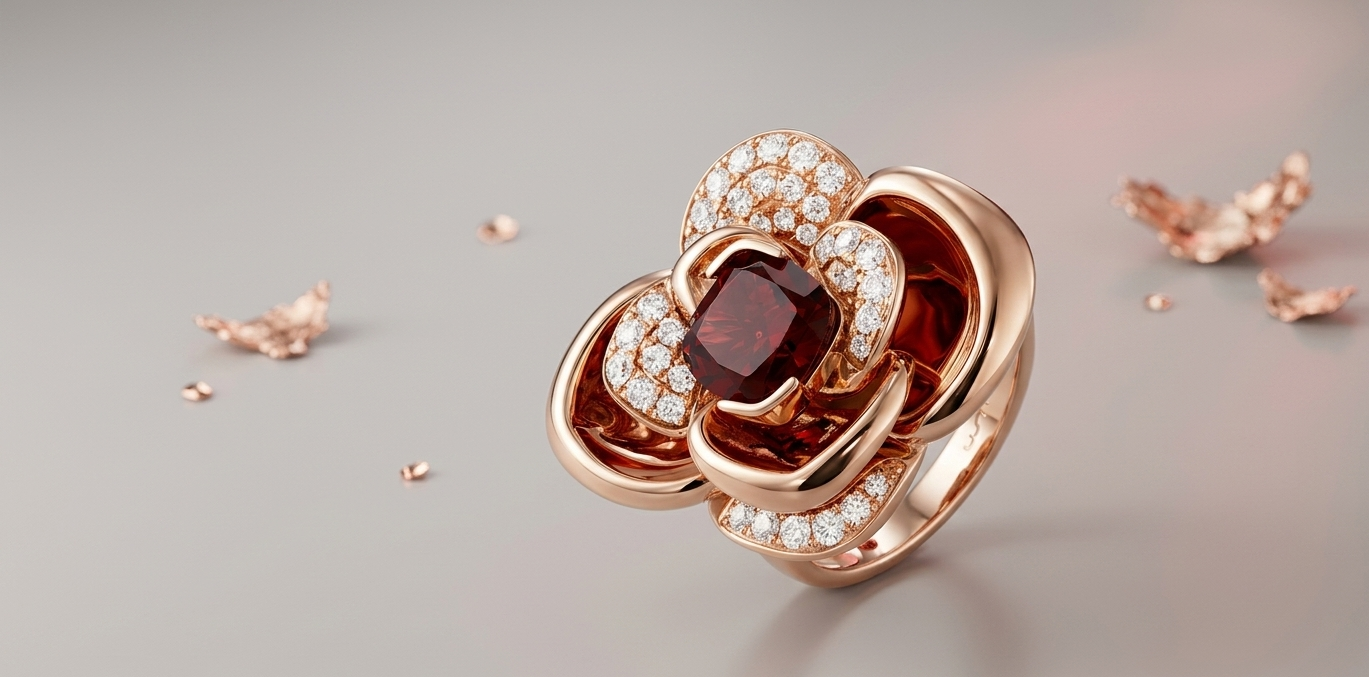

The Alchemy of Red: Why Wollem Signs Every Masterpiece in Rose Gold
In fine jewelry, the metal is the stage and the gemstone is the performer. After decades of working with Bohemian pyrope garnet, the Wollem family reached a conclusion that now defines every piece they produce: for a red garnet, there is no better stage than rose gold.
This is not a trend or a branding decision. It is the outcome of a specific color theory problem, worked through carefully and arrived at by elimination.
The Color Science Behind the Choice
Why warm and cool metals produce different results with red stones
Garnet is a warm-toned stone. Its red sits in the orange-red part of the spectrum, with undertones ranging from copper to deep ruby depending on the light source.
When a warm-toned stone is set in a cool metal — white gold or silver — the contrast is stark. The stone looks vivid but isolated, sitting on top of the metal rather than belonging to the piece. For garnet, this flattens the warmth that makes the stone interesting.
Yellow gold is warmer, but introduces a different problem: its reflective surface casts a yellowish tint into the stone. In micro-pave settings where tiny slivers of metal are visible between hundreds of small garnets, this yellow contamination makes even high-quality stones appear muddy.
What rose gold does differently
Rose gold is an alloy of gold and copper — at 14k, approximately 58.5% gold with the remainder copper and silver. The copper content gives it a pinkish-red warmth that sits close to the garnet's own spectral range.
When rose gold reflects light back into the garnet, it reflects in the red-pink range — additive rather than competitive. The metal's reflected light reinforces the stone's color. The red appears deeper, more saturated, and more internally lit than in any other metal context. Wollem calls this the chromatic match.
Rose Gold vs. Yellow Gold vs. White Gold for Garnet: Direct Comparison
Yellow Gold | White Gold | Rose Gold (14k) | |
Effect on garnet color | Adds yellowish tint — can make stone look muddy | Cold contrast — stone looks vivid but isolated | Reflects pinkish-red — deepens and warms natural saturation |
Harmony with red pyrope | Moderate — warm but wrong hue | Low — cool separation from stone | High — shares warm undertone range |
In micro-pave settings | Metal glints read yellow between stones | Metal glints read grey-white between stones | Metal glints read warm pink-red — add to overall red effect |
Durability at 14k | Good | Good | Excellent — copper content increases hardness |
Aesthetic register | Traditional, antique | Modern, industrial | Vintage-modern — Victorian warmth with contemporary finish |
Why Durability Is Part of the Decision
The choice of rose gold is not purely aesthetic. At 14k, the copper content makes rose gold harder and more resilient than yellow or white gold at the same karat — both of which prioritize color over hardness in their alloy composition.
For Wollem's micro-pave settings, where microscopic prongs hold sub-millimeter garnets in place, this structural difference matters. A harder base metal provides better long-term security. Combined with the black rhodium applied to the prongs, the result is a setting that is both visually refined and mechanically sound.
The Art of Invisibility: How Wollem Uses Black Rhodium to Perfect the Garnet
The Wollem Visual Signature
There is a practical consequence to this consistency: Wollem pieces are immediately recognizable. The combination of warm rose gold, black rhodium prongs, and continuous garnet surface produces a specific visual effect that does not resemble any other garnet jewelry on the market.
Every piece in their collection is a variation on the same fundamental equation: rose gold warmth plus black rhodium precision plus pyrope fire.
Frequently Asked Questions
Why does rose gold look best with red garnets?
Rose gold contains copper alloys that give it a pinkish-red warmth sitting close to the color range of red garnet. When rose gold reflects light back into the stone, it reflects in compatible warm tones — deepening the garnet's natural saturation rather than competing with it. Yellow gold introduces a yellowish tint that can make garnets look muddy, while white gold creates a cool contrast that isolates the stone from its setting.
What is the difference between 14k rose gold, yellow gold, and white gold?
All three are gold alloys — pure gold mixed with other metals to achieve hardness and color. Yellow gold is alloyed primarily with silver and zinc. White gold is alloyed with palladium or nickel for a silver-white look, usually finished with white rhodium plating. Rose gold is alloyed with copper, producing its pinkish warmth and making it harder and more durable than the other two at equivalent karat.
Is rose gold durable enough for everyday jewelry?
Yes — 14k rose gold is among the more durable gold alloys because of its copper content. Copper increases hardness, which improves resistance to scratching and deformation. This makes it well-suited for precision settings like micro-pave, where the structural integrity of tiny prongs matters for long-term stone security.
Does rose gold tarnish or change color over time?
Rose gold does not tarnish the way silver does. Over time, copper content can cause a very slight deepening of the pinkish tone — a patina that many wearers find appealing. This is different from tarnishing and does not affect structural quality. Unlike white gold, it does not require periodic rhodium replating to maintain its appearance.
What metal is best for garnet jewelry?
For red pyrope garnet specifically, rose gold produces the most visually coherent result because its warm copper-based tones share the same spectral range as the stone. The metal reinforces rather than competes with the garnet's color. White gold and silver work well for garnets with cooler tones, but for the deep pomegranate-red of Bohemian pyrope, rose gold is the most technically considered choice.