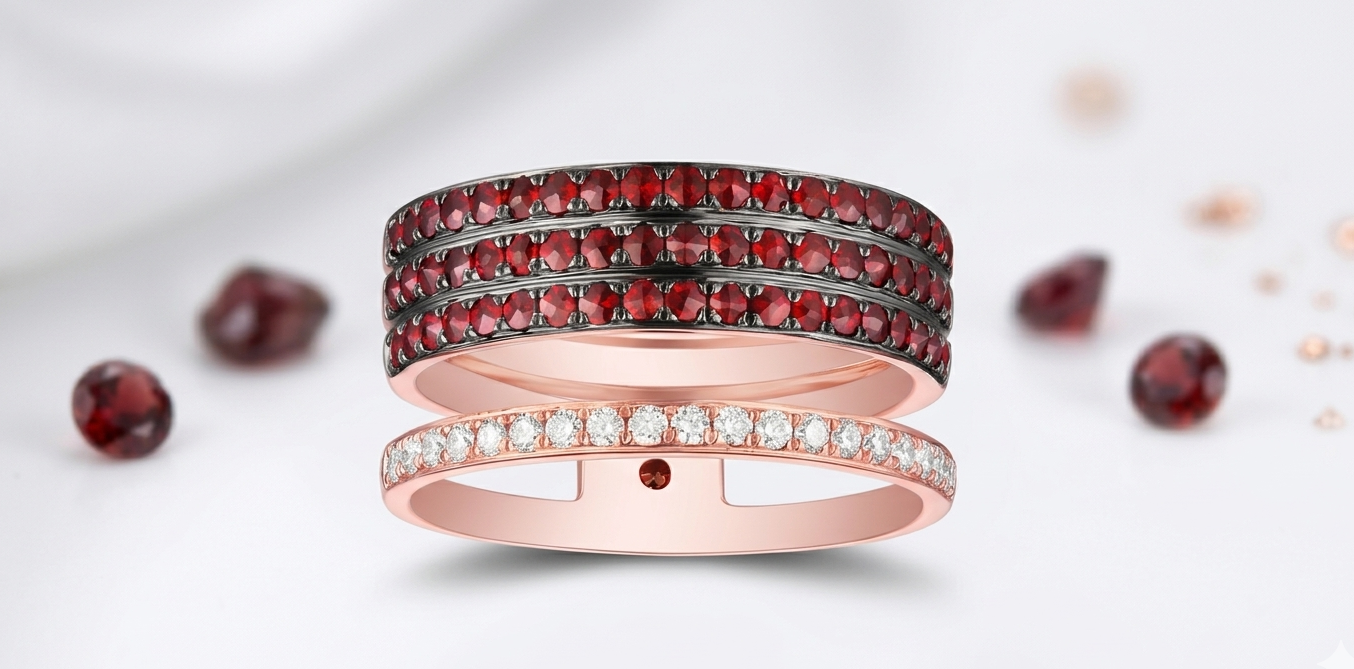

The Art of Invisibility: How Wollem Uses Black Rhodium to Perfect the Garnet
In fine jewelry, the most powerful innovations are often the ones you cannot see. At Wollem, decades of technical refinement have been devoted to a single aesthetic problem: how to let the fiery red of a garnet speak for itself, without the metal holding it getting in the way.
The answer is a technique they call the Art of Invisibility — the precise, surgical application of black rhodium to the setting architecture of each piece.
Why Metal Color Matters More Than Most People Realize
When most people evaluate jewelry, they focus on the stone. But the metal surrounding a gemstone has an enormous influence on how that stone is perceived — particularly for red stones like garnet.
Standard setting metals — yellow gold, white gold, silver — are reflective. Under light, they scatter brightness around the stone rather than concentrating it on the gem itself. For garnets specifically, this creates two problems:
The metal competes visually with the stone, drawing the eye away from the red. Reflections from light-colored metal can dilute the perceived depth and saturation of the garnet's color. The result is that many otherwise excellent garnets look flatter in traditional settings than they do in isolation. The stone is not the problem — the context is.
What Black Rhodium Does — and How Wollem Uses It Differently
Rhodium is a rare platinum-group metal used in jewelry primarily for its reflective properties — standard rhodium plating is bright white and is commonly applied to white gold to give it a mirror finish.
Black rhodium is a different application: it produces a dark, matte-to-satin surface that absorbs light rather than reflecting it.
Many jewelry brands apply black rhodium across the entire surface of a piece as a design choice — producing a dark, monochromatic look. Wollem uses it differently.
The Wollem approach: targeted application only
At Wollem, black rhodium is applied exclusively to the microscopic prongs holding each garnet — not to the body of the piece. The surrounding 14k rose gold remains untouched.
This requires a level of precision that is genuinely difficult to execute at scale. The rhodium must be applied after the stones are already set, using tools that work at sub-millimeter tolerances. A single error contaminates the rose gold surface and requires reworking the piece from that point forward.
This is one of the reasons Wollem describes the process as requiring both time and obsession — and why it cannot be replicated in mass production.
The Three-Layer Contrast: Rose Gold, Black Rhodium, and Garnet
The full visual logic of a Wollem piece depends on three elements working together:
14k Rose Gold — the body of the jewelry. Rose gold has a warm, slightly vintage quality that reads as contemporary when paired with modern design. It provides the visible structure and warmth of the piece.
Black Rhodium — the hidden architecture. Applied only to the prongs, it creates a dark shadow layer that absorbs the light immediately around each stone. The eye reads this as the garnet floating rather than being held.
The Garnet — the sole point of focus. With the metal receding visually, all available light and attention converges on the stone. The red appears more saturated, more pomegranate-vivid, than in any standard setting.
This layering also produces different visual results depending on the angle and light source — which is part of what makes the pieces dynamic to wear rather than static to look at in a case.
Why Black Rhodium and Micro-Pavé Work Together
Black rhodium becomes especially effective when combined with micro-pave setting — the technique Wollem uses to set hundreds of sub-millimeter garnets in a continuous surface.
In micro-pave, the metal between stones is already minimal. The prongs are microscopic. But even microscopic prongs catch light and interrupt the visual field when they are gold or silver.
When those same prongs are black rhodium, they effectively disappear. The entire surface reads as an uninterrupted field of red — what Wollem describes as a skin of fire.
Why Most Jewelry Brands Do Not Use This Technique
Black rhodium targeted application is avoided by most producers for straightforward reasons:
It significantly increases production time — each piece requires individual attention at the plating stage
It demands craftsmanship standards that do not scale — the margin for error at sub-millimeter tolerances is essentially zero
It requires a fully integrated atelier where the same team controls setting and finishing — outsourced production chains cannot maintain the consistency needed
For volume-oriented brands, the economics simply do not work. The technique is reserved for houses willing to treat each piece as an individual object rather than a unit of production.
Frequently Asked Questions
What is black rhodium and why is it used in jewelry?
Rhodium is a rare platinum-group metal. Black rhodium is a specific application that produces a dark, light-absorbing surface rather than the bright reflective finish of standard rhodium. In jewelry, it is used either as a full design statement (darkening an entire piece) or — as in Wollem's approach — as a targeted tool to make specific metal elements visually recede, drawing more attention to the gemstones.
Why does Wollem use black rhodium on garnet jewelry?
Wollem applies black rhodium specifically to the microscopic prongs holding each garnet. This creates a dark background immediately around each stone that absorbs surrounding light rather than reflecting it. The result is that the garnet's red color appears more saturated and vivid — because the eye has no competing reflections to process. Combined with their micro-pave setting and 14k rose gold base, this produces their signature three-layer contrast effect.
Is black rhodium durable on jewelry?
Black rhodium plating does wear over time, particularly on high-contact surfaces like ring bands. The rate of wear depends on the thickness of the plating and how the piece is used. On prong surfaces — where Wollem applies it — contact is minimal, which extends durability. A reputable jeweler will be transparent about maintenance requirements and replating options for long-term ownership.
What is the difference between black rhodium and standard white rhodium plating?
Standard white rhodium produces a bright, mirror-like reflective surface and is most commonly used on white gold to enhance its brilliance. Black rhodium produces a dark, matte-to-satin finish that absorbs light. They serve opposite optical purposes: white rhodium maximizes reflection, black rhodium minimizes it. For garnet jewelry specifically, black rhodium is more effective because it eliminates visual competition between the metal and the red stone.
What does 'Art of Invisibility' mean in Wollem jewelry?
Art of Invisibility is Wollem's term for their targeted black rhodium application technique. The goal is to make the metal setting disappear visually so that only the garnet is perceived. By plating only the prongs — not the rose gold body of the piece — the stones appear to float on the surface rather than being held in place. It is a description of the optical effect as much as the technical process.
Why does my garnet look less vivid in some jewelry than others?
The metal surrounding a garnet has a significant effect on its perceived color. Reflective metals like yellow gold, white gold, and silver scatter light around the stone, which can dilute the appearance of the red. Dark or matte settings — like black rhodium — create contrast that makes the same stone appear more saturated. Stone quality matters too: garnets with visible inclusions or inconsistent color will appear flat in any setting.