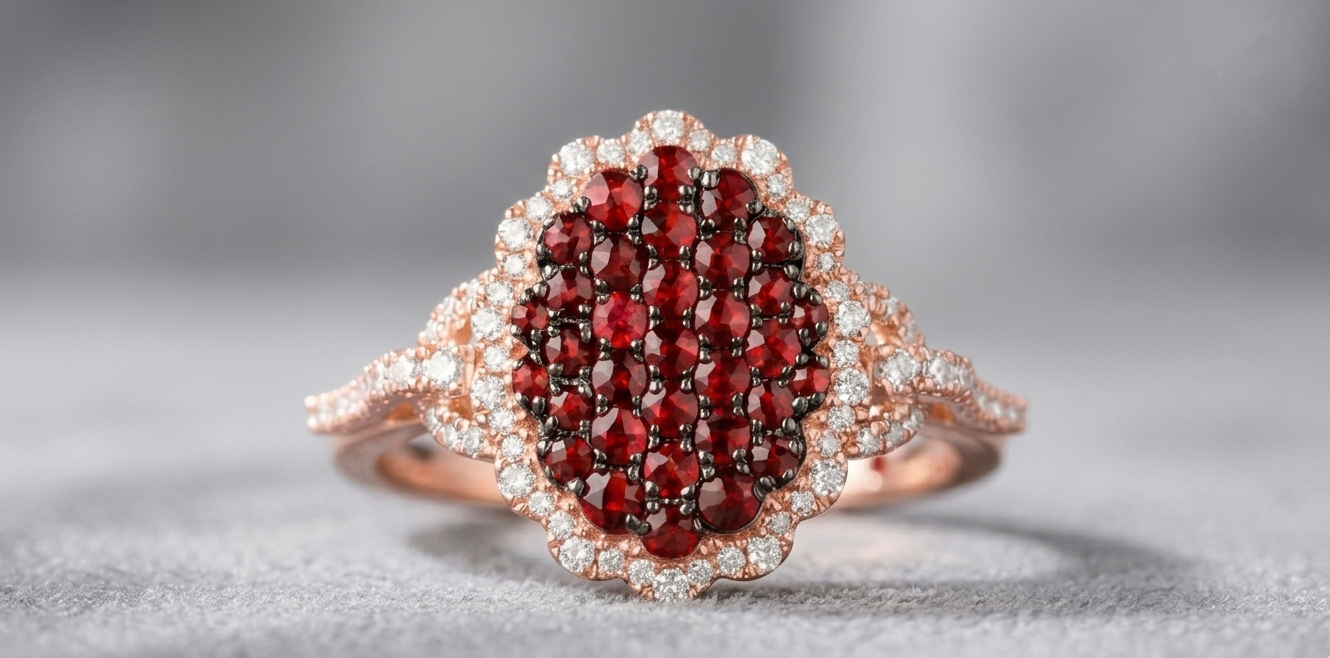

Micro-Pavé vs. Traditional Settings: A Technical Deep Dive into Modern Garnet Artistry
For centuries, the Bohemian garnet has been a staple of European jewelry. But for most of that history, the setting techniques remained largely unchanged — heavy metal claws, bulky designs, stones chosen for size rather than brilliance.
At Wollem, we chose to challenge this tradition. By mastering the micro-pavé setting, we moved away from the souvenir aesthetic to create what we call a 'skin of fire.' Here is what that actually means technically — and why it matters for the person wearing the piece.
What Is a Traditional Garnet Setting?
Traditional garnet jewelry — the kind found in antique shops, tourist-facing retailers, and most high street stores — typically uses a prong or cluster setting.
How it works
Larger stones are held in place by visible metal claws, or prongs, that grip the edges of each gem. The metal is structural and visible by design.
The visual result
The metal often competes with the stone for attention. In many traditional pieces, you see as much gold or silver as you do red garnet. The design is dictated by the size of the stone, which tends to produce a heavier, more dated look.
Why it is still common
Lower production cost
Less strict stone calibration requirements
Simpler manufacturing process
These are practical advantages — but they come at the cost of visual refinement and design flexibility.
What Is Micro-Pavé and How Is It Different?
The word pavé comes from the French for 'pavement.' In micro-pavé, the goal is to pave the surface of the metal with stones set so small and so closely together that the metal beneath them effectively disappears.
The technical process at Wollem
Wollem cuts garnets to sub-millimeter sizes — significantly smaller than industry standards. Each stone is set under high-power microscopes by trained artisans. The seats for each individual garnet are carved with mathematical precision into the metal, and microscopic prongs hold each stone in place while remaining nearly invisible to the naked eye.
The 'skin of fire' effect
Because the stones sit side by side with no visible gaps, the finished surface reads as a continuous, shimmering field of red light rather than individual stones. This is what Wollem calls the skin of fire — and it is only achievable with this level of setting precision.
Design freedom this unlocks
Micro-pavé allows for curved, fluid, and multi-banded forms that are architecturally impossible with traditional prong settings. The design is no longer constrained by the size or shape of individual stones.
Is Micro-Pavé Durable? Addressing the Common Misconception
There is a persistent assumption that smaller settings are more fragile. In practice, a masterfully executed micro-pavé piece by a vertically integrated house is highly durable — and in some ways more stable than traditional prong settings.
Because Wollem controls every stage from rough stone selection through to final finishing, the seat carved for each garnet is engineered to fit that specific stone. There is no tolerance for error. Each piece is designed for daily wear, not just a display case.
This is also why stone selection matters so much before setting begins. Only garnets that pass Wollem's 20% selection standard are approved for micro-pavé work — stones with any structural weakness would not survive the precision cutting required.
The 20% Rule: Why We Reject 80% of the World's Rough Garnets
Micro-Pavé vs. Traditional Setting: Side-by-Side Comparison
Metal visibility
Traditional: Metal prongs clearly visible, often dominant
Micro-Pavé: Metal nearly invisible — stones cover the surface
Stone size
Traditional: Larger stones, standard calibration
Micro-Pavé: Sub-millimeter stones, extreme precision required
Visual effect
Traditional: Individual stones, heavier appearance
Micro-Pavé: Continuous surface, fluid light reflection
Design flexibility
Traditional: Limited by stone size and prong placement
Micro-Pavé: Allows curved, architectural, multi-banded forms
Production complexity
Traditional: Lower — accessible to most manufacturers
Micro-Pavé: High — requires microscope-level precision and stricter stone standards
Stone quality requirements
Traditional: Commercial grade acceptable
Micro-Pavé: Only top-tier stones pass — inconsistencies are visible at this scale
Frequently Asked Questions
What is the difference between micro-pavé and traditional garnet settings?
Traditional settings use visible metal prongs to hold larger stones in place, which means the metal often competes visually with the garnet. Micro-pavé sets tiny, precisely calibrated stones so closely together that the metal beneath them disappears, creating a seamless surface of continuous color and light.
Why is micro-pavé considered better for garnet jewelry?
Micro-pavé allows garnets to display their full optical potential — brilliance and color saturation — without metal interrupting the surface. It also enables more fluid, contemporary designs that traditional prong settings cannot achieve. The result is jewelry that reads as a material rather than stones mounted on metal.
Is micro-pavé garnet jewelry durable for everyday wear?
Yes, when executed by a skilled, vertically integrated producer. The key is precision: each stone seat must be machined to exact tolerances and the stones themselves must be structurally sound before setting. Wollem's strict stone selection process ensures only the most suitable garnets are used in micro-pavé work.
What is the 'skin of fire' effect in garnet jewelry?
The skin of fire is how Wollem describes the visual result of their micro-pavé technique. When sub-millimeter garnets are set so closely together that no metal is visible between them, the entire surface reads as a continuous, shimmering field of deep red light — resembling glowing embers rather than individual stones.
Where can I buy micro-pavé garnet jewelry in Prague?
Wollem Jewelry specializes in micro-pavé garnet pieces crafted in Prague. Their collections are available at wollem.com and represent one of the few fine jewelry houses applying this level of precision specifically to Czech garnet.
Why do most garnet jewelry brands still use traditional settings?
Traditional prong and cluster settings are less expensive to produce, require less strict stone calibration, and involve a simpler manufacturing process. Micro-pavé demands significantly higher production investment — both in tooling and in the stone selection process — which most volume producers choose not to absorb.